



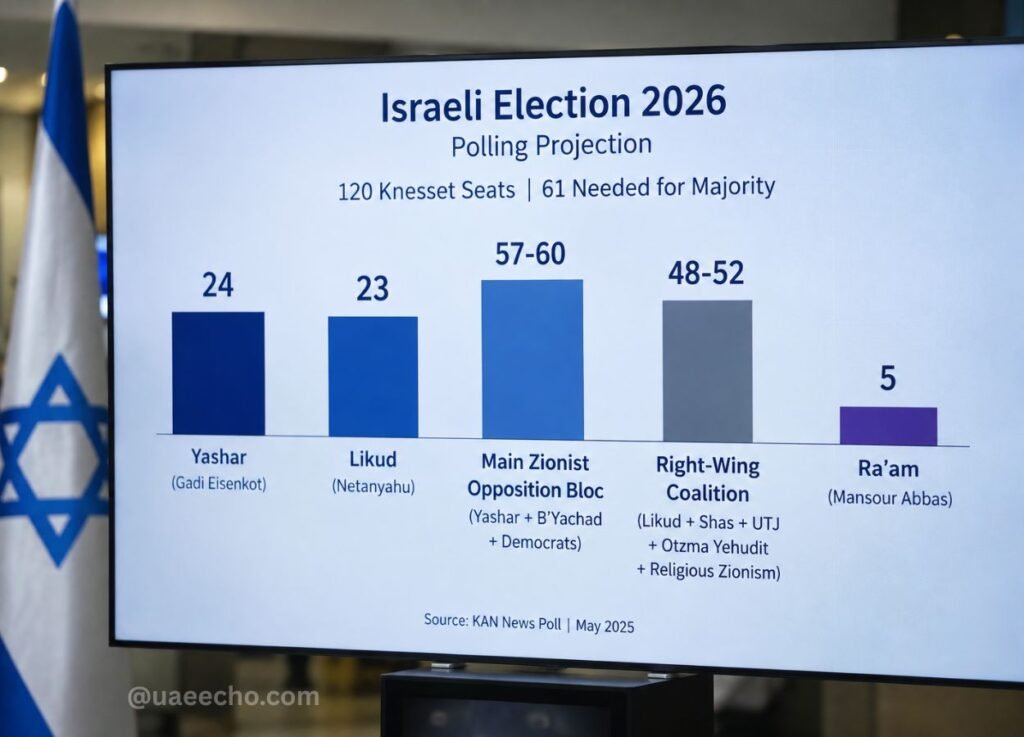
Former IDF Chief of Staff Gadi Eisenkot has emerged as the principal challenger to Benjamin Netanyahu’s premiership ahead of Israel’s October 2026 general election, with recent opinion polls showing his newly formed Yashar party pulling ahead of the ruling Likud while pushing the main Zionist opposition bloc within a single seat of a parliamentary majority.
Latest pre-election surveys published by KAN News and regional media outline a significant shift in voter momentum following Likud’s internal primaries. Eisenkot’s Yashar is projected to take 24 mandates in the 120-seat Knesset, narrowly edging out Likud’s 23 seats. Coupled with former Prime Minister Naftali Bennett’s B’Yachad party and Yair Golan’s Democrats, the main Zionist anti-Netanyahu opposition coalition sits between 57 and 60 seats—hovering directly on the precipice of the 61-seat majority required to form a government without relying on Arab-majority factions.
Netanyahu’s incumbent right-wing coalition comprising Likud, ultra-Orthodox parties Shas and United Torah Judaism, and far-right allies Otzma Yehudit and Religious Zionism—has stagnated at 48 to 52 seats, reflecting public frustration over post-war accountability, economic pressure, and ongoing legislative disputes regarding Haredi military conscription.
Despite Eisenkot’s momentum, political analysts emphasize that securing a governing coalition remains complex. If Zionist opposition parties finish at 60 seats, the path to a 61-seat majority depends either on reaching agreements with Mansour Abbas’s Ra’am party (projected at 5 seats) or enticing defectors from right-wing or military reservist lists. However, explicit reliance on Arab factions presents ideological friction for centrist and right-leaning voters in Eisenkot’s base.
With the official deadline for party list submissions fast approaching in September and campaigning intensifying across the country, Eisenkot’s steady rise marks the most direct threat to Netanyahu’s long-standing grip on Israeli politics in recent election cycles.